
A Letter to the Woman I Postponed
On Italy, belonging, and the tables that shape us
A few years ago, my son looked at me across a table in Italy and said: “Mum, you're like a round peg in a round hole here.”
I laughed.
Then I realised he was right.
For the first time, someone else had seen what I had always known: that Italy is where I feel most at home.
I was born and raised in England. My parents came from Minori on the Amalfi Coast, and our life was in Lancashire. I went to school in England, spoke English every day and understood all the references everyone else understood.
On paper, there was nothing unusual about my childhood.
Yet our home existed in a world of its own.
The food was Italian. The language was Italian, Neapolitan to be more precise. So too were the conversations, the values, the humour and the rhythms of family. My mother would call from the kitchen “a tavola!” and whatever was happening, we came. The table was where life gathered. News was shared. Opinions were offered whether anybody wanted them or not. There was laughter, disagreement, gossip, celebration and the reassuring sense that however chaotic life felt outside, everybody had a place there.
I assumed every family lived this way.
Then I started visiting friends' houses and realised they didn't. I remember feeling quietly puzzled by how quickly meals came and went. Everyone would eat and disappear. The evening continued, but the gathering ended.
At home, the gathering was the point.
At fifteen I didn't have the language for culture, identity or belonging. I simply knew that whenever I was in Italy I felt different. More connected with what I understood to be my life. More at ease in my own skin.
England was where I lived.
Italy was where I made sense.
I knew it when I spent almost a year studying in Pavia, and wanted desperately to stay. I knew it every time I returned and felt something inside me settle.
My mother died when my children were still young, and for a while it felt as though my world had been turned upside down. I built a business so I could be there for them. There were school runs, deadlines, responsibilities, practicalities and all the years when other people needed me. Those years were probably the hardest I have ever experienced, but somehow I kept things going and look back with gratitude that I was able to run my business completely around the needs of my children, right into adulthood.
For many years I believed that during that time I had lost myself. But in fact, I had merely postponed myself.
The part of me that made sense in Italy was just waiting.
For years I told people I missed Italy. What I have come to understand is something different.
When I am in Italy, I hear my mother's voice. I hear her language. I see the culture that shaped her and, through her, shaped me. I understand why she cooked the way she did, loved the way she did and gathered people the way she did.
It is not a country I miss.
It is the place where I feel closest to the part of myself that came through her.
And perhaps that is why, after all these years, I find myself stepping back towards an inheritance I never really left, but had somehow learned to stand outside of.
Sometimes travel brings us back to who we have always been.
Because the truth is, the tables of our lives are always changing. The family table we grew up around becomes something different. The one we create for our own children eventually grows quieter. Parents leave us. Children build lives of their own. Friendships evolve. The shape of our lives changes and, with it, the shape of the table.
And somewhere in that shifting, many of us begin to ask questions we never expected to ask.
Who am I now?
What comes next?
Where do I belong?
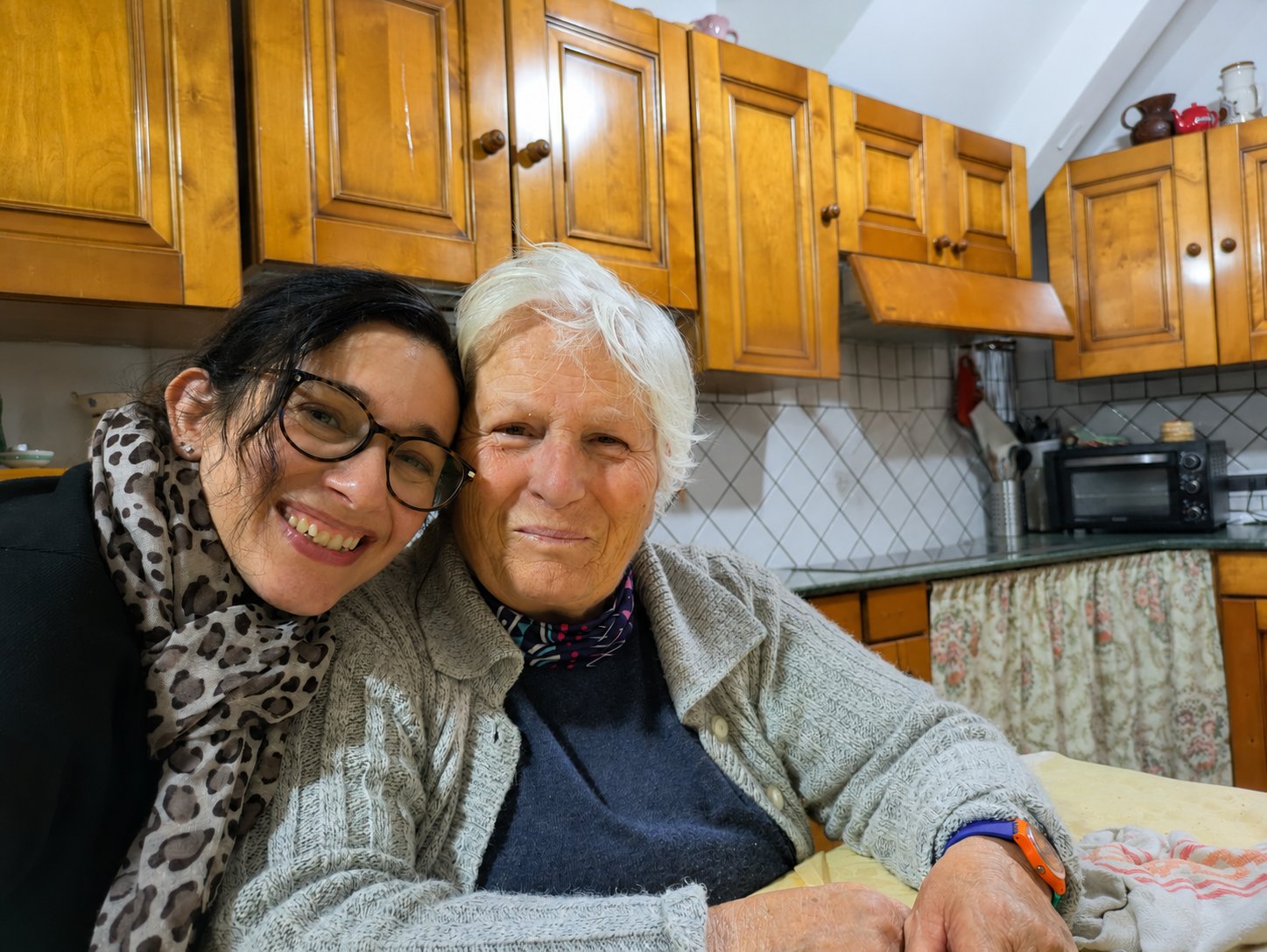
A few months ago, I sat at my Zia Giovanna's table in Minori.
I had expected lunch for a few people.
Instead, the table had been extended. Children, grandchildren, friends and neighbours drifted in and out throughout the afternoon. Lunch became coffee. Coffee became conversation. Conversation became stories. More chairs appeared when they were needed.
Life has not always been easy on my aunt. She has experienced loss and grief and disappointment. Time has taken things from her.
Yet she continues to gather people. She still makes room.
Watching her move between the kitchen and the people she loves, I realised that what moved me had nothing to do with food.
The table is not really where we just eat.
It is where belonging becomes tangible.
She would never describe it that way, of course. She would tell me to stop overthinking and come and eat. But I think she understands something that took me much longer to see.
The tables of our lives will always change. People will come and go. Seasons will open and close. Entire chapters may end before we are ready.
Looking back, I realise I did not lose the woman I thought I had lost.
She was there all along, waiting patiently for me to stop postponing her.
If I could write to her now, the girl at fifteen, the woman at thirty, the woman holding everything together while her own table grew quieter, I think I would tell her this:
You were never gone.
And perhaps that is why I find so much comfort in the example of my mother and my aunt. They taught me that we do not always choose the shape of our lives, or the things that happen within them.
Life changes. Tables change. People come and go.
But watching my aunt gather the people she loves, and seeing the joy she still takes in welcoming them, I realised something that took me a long time to understand.
Perhaps we are not here only to prepare the table for everybody else.
Perhaps we are meant to sit down at it too.
And perhaps, after all these years, I am finally learning to do the same.